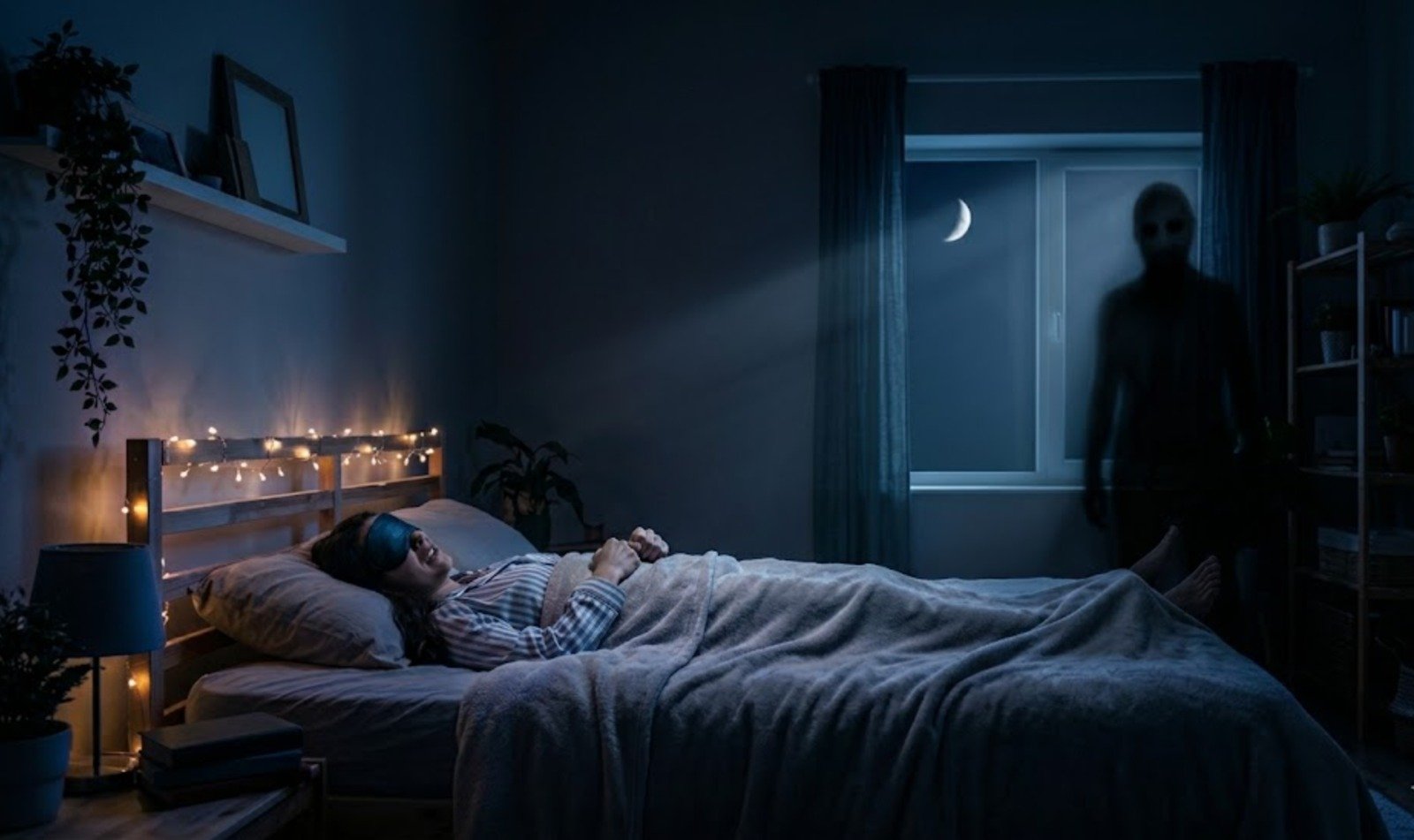
Across cultures and centuries, people have described waking in the night unable to move, feeling a weight on the chest, and sensing that something is in the room. The descriptions match closely. The explanations do not match at all - the same experience has been attributed to a witch, a jinn, a demon, an ancestor, an alien, and a misfiring of REM sleep.
That gap between a stable experience and wildly varying interpretations is the most interesting thing about sleep paralysis, and it is where any honest answer has to start.
What is happening physically
During REM sleep the body is paralysed. This is REM atonia, a normal mechanism that stops you physically acting out dreams. Sleep paralysis occurs when awareness returns before that paralysis lifts. You are awake, conscious, and unable to move voluntary muscles - though breathing and eye movement continue normally.
Because the brain is still partly in REM, dream imagery can carry over into the waking room. That produces hypnagogic or hypnopompic hallucinations layered onto real surroundings, which is why the experience feels like something happening in the bedroom rather than like a dream.
It is common. A systematic review by Brian Sharpless and Jacques Barber, published in Sleep Medicine Reviews in 2011, pooled data across dozens of studies and found a lifetime prevalence of roughly 7.6% in the general population, rising to about 28% among students and around 32% among psychiatric patients. Somewhere close to one person in thirteen has experienced this at least once.
None of that is disputed. It is standard sleep medicine, and it is covered in more practical detail in our guide to what sleep paralysis is and how to end an episode calmly.
The three features that keep recurring
What makes the spiritual readings so persistent is that the experience has unusually consistent content. Three elements appear again and again, largely independent of who is describing them:
- Awareness with immobility. Fully awake, unable to move or speak, often unable to call out.
- Chest pressure. A weight or crushing sensation, sometimes with a feeling of suffocation.
- A sensed presence. The strong conviction that someone or something is in the room, frequently near the head or at the foot of the bed, usually experienced as hostile.
That third feature is the one that generates the interpretations. A sensed presence is not a vague unease - it typically arrives with the specificity and certainty of a perception, and it is deeply frightening.
What different cultures have called it
The naming is remarkably consistent in what it describes and remarkably varied in what it blames.
| Tradition | Name | The attributed cause |
|---|---|---|
| Newfoundland | Old Hag | An old woman who sits on the sleeper’s chest |
| Japan | Kanashibari | Being “bound in metal”, often by a spirit |
| Egypt and the Arab world | Jinn attack | A jinn pressing or strangling the sleeper |
| Turkey | Karabasan | A dark presence that holds the body down |
| Brazil | Pisadeira | A thin old woman who treads on the chest |
| Scandinavia and Germany | Mara | A crushing spirit that rides the sleeper |
| Philippines (Ilocano) | Batibat | A tree spirit that sits on the sleeper |
| Zanzibar | Popobawa | A shapeshifting nocturnal assailant |
| St Lucia | Kokma | The spirit of a dead infant that grips the throat |
The English word nightmare carries the trace of this. It comes not from a horse but from the mare - the same Germanic mara, a spirit that crushes sleepers. The word originally named the experience described here, and only later drifted to mean a bad dream.
The best-known depiction is Henry Fuseli’s painting The Nightmare (1781), which shows a squat figure crouching on the chest of a sleeping woman. It is widely read as a depiction of exactly this state, painted more than two centuries before the mechanism was understood.
The researcher who noticed the pattern
The person who made this a serious field of study was the folklorist David Hufford. His book The Terror That Comes in the Night (1982) examined the Newfoundland “Old Hag” tradition and reached a conclusion that unsettled both sides of the argument.
Hufford found that people were reporting the same specific experiential features whether or not they knew the tradition beforehand - including people with no cultural framework for it at all. His argument was that the experience has a stable core that is not produced by belief, and that the folklore grows up around it rather than generating it.
This cuts against the easy sceptical position that people simply hallucinate whatever their culture supplies. The core content appears first; the explanation is fitted to it afterwards.
Does what you believe change the experience?
There is evidence that it changes how bad it is.
Comparative work by Baland Jalal and Devon Hinton examined sleep paralysis in Egypt and Denmark. Egyptian participants were far more likely to interpret episodes as jinn attacks, and reported greater fear and longer-feeling episodes. Danish participants, who overwhelmingly framed it physiologically, reported less distress.
The reasonable reading is that the trigger is biological, but the interpretation shapes the suffering. If you believe a malevolent entity is attacking you, the fear is worse and the episode is harder to break out of - and fear itself tends to prolong these states.
That has a practical implication. Understanding the mechanism does not make the experience less strange, but it does reliably make it less frightening.
The religious interpretations
These deserve to be represented accurately rather than dismissed.
Christian readings often frame the experience as spiritual oppression or attack, and the common response is prayer or invoking the name of Jesus. Many people report that this ends the episode. It is worth noting that a calm, focused, repeated verbal or mental action is also, in purely mechanical terms, one of the things that helps break the state - which is not an argument against prayer, but does mean the outcome is consistent with both explanations.
Islamic readings commonly attribute it to jinn, which are described in the Qur’an as created beings with their own agency. Recitation, particularly of Ayat al-Kursi, is the usual response.
Spiritualist and New Age readings vary widely: an interrupted out-of-body experience, a sign of opening psychic sensitivity, an encounter with a discarnate entity, or a passage into the vibrational stage. Where the figures are dark and humanoid, they are often identified with shadow people.
Some traditions read it positively - as an ancestor making contact, or as a threshold state with something to teach.
What can be said fairly: none of these interpretations has been demonstrated, and none has been ruled out either, because they make claims that fall outside what sleep research is able to test. What sleep research can say is that the physical event does not require an external agent to explain it.
Does the Bible mention sleep paralysis?
Not by name. Two passages come close - Job 4:13-16, where Eliphaz describes night terror and a spirit passing before his face, and Daniel 10:8-9, where Daniel loses all strength and lies immobile while aware of a vision. Neither names the condition, and the “sleep paralysis demon” is a folklore category rather than a scriptural one.
Because this is the single most-asked version of the question, we treat it separately and in full in what the Bible says about sleep paralysis, including the spiritual-attack question and where prayer fits.
If it is happening to you
The things that reliably reduce episode frequency are unglamorous and well established:
- Sleep enough, and at consistent times. Sleep deprivation and irregular schedules are the strongest identified triggers.
- Avoid sleeping flat on your back. Supine position is associated with markedly higher rates.
- Address stress and anxiety, which are consistently correlated with frequency.
During an episode, the standard advice is to focus on moving a single small muscle - a fingertip, a toe - or on controlling the breath, and to let the state pass. It always does. Fighting the paralysis with your whole body tends to intensify the panic without shortening the episode.
When to see a doctor. Recurrent sleep paralysis combined with sudden daytime sleepiness, or with episodes of muscle weakness triggered by strong emotion, can indicate narcolepsy, which is diagnosable and treatable. Frequent episodes causing real distress or fear of sleeping are also worth raising with a GP. This is a genuine medical threshold, not a spiritual failure.
Common questions
Is sleep paralysis a spiritual attack?
It is a documented sleep phenomenon with a known mechanism. Whether something further is occurring is a question of belief, and one that sleep research is not equipped to settle in either direction. What is clear is that the physical event needs no external cause to explain it.
Why do so many people see the same dark figure?
The sensed presence appears to be a fairly stable feature of the state itself, which is Hufford’s central point. What the figure looks like in detail tends to follow cultural expectation; that something is there appears not to.
Does it mean I am spiritually gifted or opening up?
There is no evidence connecting sleep paralysis to psychic ability. It correlates with sleep deprivation, irregular schedules, stress and sleeping on your back.
Can it hurt me?
No episode has been documented as physically harmful. The distress is real; the danger is not.
Is it connected to astral projection?
They involve overlapping states. Practitioners often describe sleep paralysis as a threshold, and some deliberately use it as an entry point. The physiology is the same either way - what differs is the interpretation and the response.
Sources and further reading
- Sharpless, B. A., & Barber, J. P. (2011). Lifetime prevalence rates of sleep paralysis: a systematic review. Sleep Medicine Reviews, 15(5), 311-315.
- Hufford, D. J. (1982). The Terror That Comes in the Night: An Experience-Centered Study of Supernatural Assault Traditions. University of Pennsylvania Press.
- Jalal, B., & Hinton, D. E. (2013). Rates and characteristics of sleep paralysis in the general population of Denmark and Egypt. Culture, Medicine, and Psychiatry, 37(3), 534-548.
- Fuseli, H. (1781). The Nightmare. Detroit Institute of Arts.