The Bible does not mention sleep paralysis. There is no passage describing it, no term for it, and no instruction about what to do when it happens.
That is worth saying at the start, because a great deal of what circulates online implies otherwise. What scripture does contain is two passages describing night-time experiences that resemble it closely enough to be worth examining honestly - and a broader framework about fear and night that many Christians find more useful than either.
If you are here because it happened to you and it frightened you, the short version is at the end. The passages come first because they are what people ask about.
Job 4:13-16 - the passage most often cited
Eliphaz describes a night vision:
In thoughts from the visions of the night, when deep sleep falleth on men, fear came upon me, and trembling, which made all my bones to shake. Then a spirit passed before my face; the hair of my flesh stood up.
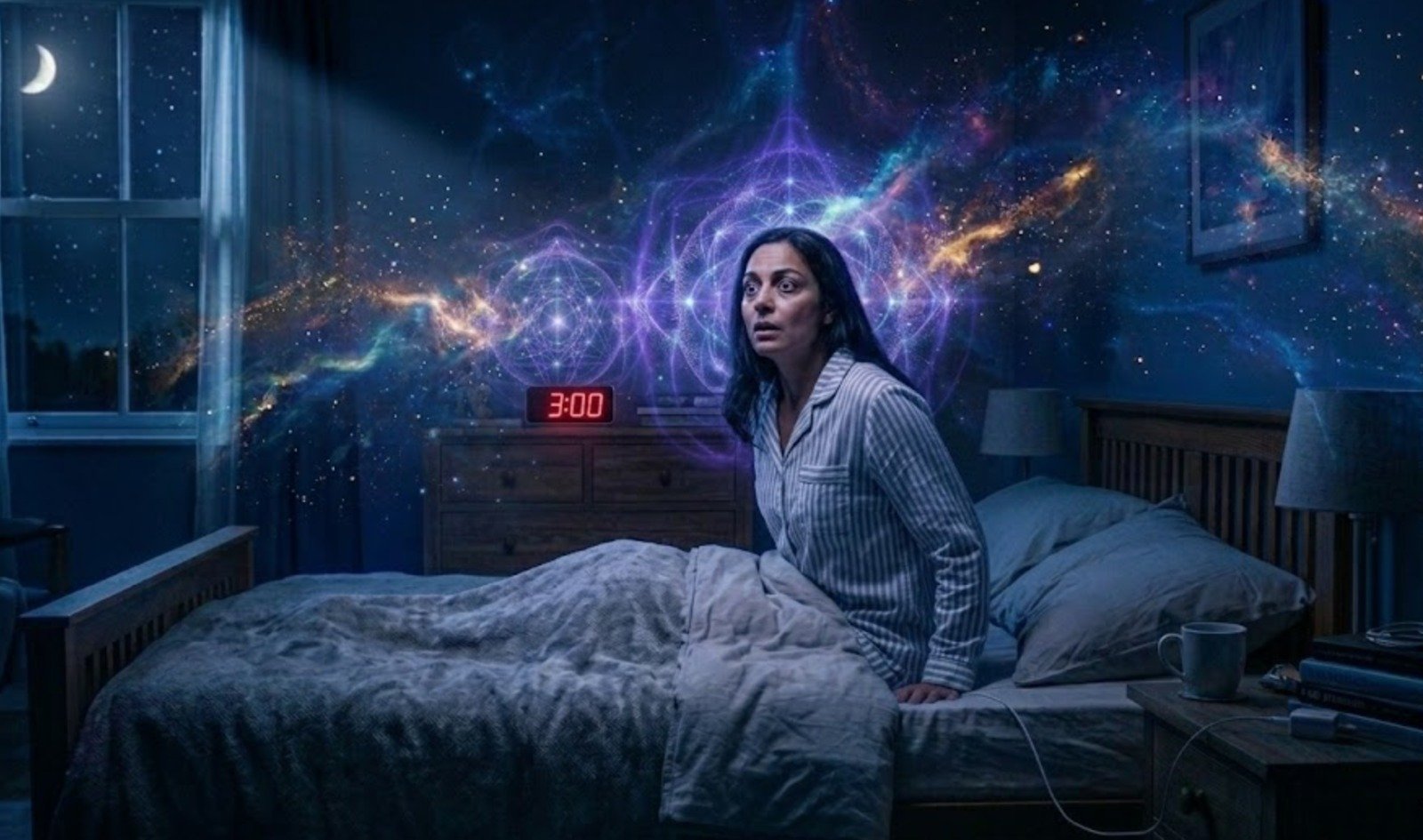
The resemblance is real. Night, the threshold of sleep, overwhelming fear, physical trembling, a sensed presence. Anyone who has had an episode will recognise the description.
But two things are worth noticing. The passage does not describe immobility, which is the defining feature of sleep paralysis - Eliphaz is frightened, not paralysed. And in the narrative it functions to establish the authority of a prophetic vision, not to record a sleep disturbance. Eliphaz is building a case; the vision is his evidence.
There is a further irony. Eliphaz is one of Job’s three friends, and by the end of the book God rebukes them for speaking wrongly about him. The passage most often cited as a biblical account of spiritual night terror is spoken by a character the text ultimately treats as unreliable.
Daniel 10:8-9 - the closer parallel
Less frequently cited, and the better match:
Therefore I was left alone, and saw this great vision, and there remained no strength in me… then was I in a deep sleep on my face, and my face toward the ground.
Here you do get the missing element. Daniel loses physical strength, cannot act, and is face-down and immobile while remaining aware of a vision and a voice. Awareness plus incapacity is precisely the structure of sleep paralysis.
The difference is in the framing. Daniel’s episode is presented as an encounter with a messenger who then strengthens him and delivers information. It is a revelation, not an assault - which is close to the opposite of how the experience is usually interpreted today.
What the Bible does not say
- It does not name the condition.
- It does not describe recurring night immobility as demonic.
- It contains no instruction, ritual or prayer directed at it.
- The “sleep paralysis demon” is not a biblical category. That phrase comes from folklore - the Old Hag, the mara, the jinn - and entered English through those traditions, not scripture.
Anyone stating firmly that the Bible identifies sleep paralysis as demonic attack is extending the text rather than quoting it.
Is it a spiritual attack?
This is the question underneath almost every search that leads here, and it deserves a straight answer rather than a comfortable one.
What is documented: sleep paralysis is a well-understood sleep phenomenon. REM atonia - the paralysis that normally stops you acting out dreams - persists briefly after you wake. Dream imagery carries over into the room. A systematic review by Sharpless and Barber found it affects roughly 7.6% of people at least once. The sensed presence, the chest pressure and the immobility are standard features, reported by people of every faith and none, including those who have never heard of it. We cover the mechanism and the cross-cultural picture in what sleep paralysis means spiritually.
What that settles: the physical event does not require an external agent to explain it. Something happening in your body accounts for what happened in your room.
What it does not settle: whether anything further is occurring. That is a theological question, and sleep research is not equipped to answer it in either direction.
Many Christians hold both: that the mechanism is physiological and that the enemy can exploit fear. That position is coherent, and nothing here contradicts it.
Prayer, and what people report
A great many people say that praying, or saying the name of Jesus, ended an episode. This is one of the most consistently reported things about Christian experience of sleep paralysis, and it should not be waved away.
Two things can be said, and holding both is more honest than choosing one.
The experience is real, and for people who pray, the relief is real.
It is also true that a calm, focused, repeated mental action is - mechanically - among the things that help an episode end. Attempting to speak, focusing attention, breathing steadily: these interrupt the panic response, and panic is what prolongs the state. That is not an argument against prayer. It is a reason the two accounts predict the same outcome, which means the outcome cannot decide between them.
If prayer helps you, pray. It costs nothing, it is consistent with your faith, and it will not make the episode worse.
Psalm 91 and the terror by night
For readers who want scripture to hold onto, the passage that fits best is not Job but Psalm 91:
Thou shalt not be afraid for the terror by night.
It does not diagnose anything, and it makes no claim about mechanism. What it does is address the actual problem - fear at night - which is what most people are seeking help with. It is the passage most commonly recommended pastorally, and reasonably so.
How different traditions respond
Evangelical and Pentecostal. Most likely to treat recurring episodes as spiritual oppression, and to recommend prayer, renunciation and sometimes deliverance ministry.
Catholic. No specific teaching on it. Prayer and sacramental practice would be the ordinary counsel, alongside an expectation that natural explanations are considered first.
Mainline Protestant. Typically treats it as a medical matter with pastoral support.
Orthodox. Cautious about attributing spiritual significance to unusual experiences without guidance, on the basis that discernment is difficult.
What almost all of them share is a caution against jumping to a supernatural explanation before a natural one has been ruled out.
What actually helps
Both the medical and pastoral advice converge here, which is unusual and probably meaningful.
- Sleep enough, on a regular schedule. Sleep deprivation and irregular timing are the strongest identified triggers.
- Avoid sleeping flat on your back, which is associated with markedly higher rates.
- Address anxiety. Fear feeds the cycle - the more frightening you find it, the more likely it recurs and the worse each episode is.
- During an episode, focus on moving one fingertip or toe, or on your breathing, and let it pass. It always does. Pray if that is your practice.
- See a doctor if episodes are frequent, or if they come with sudden daytime sleepiness or emotion-triggered muscle weakness, which can indicate narcolepsy. This is a real medical threshold and not a failure of faith.
Common questions
Is sleep paralysis in the Bible?
No. Job 4:13-16 and Daniel 10:8-9 describe night experiences with some resemblance, but neither names or describes the condition.
Is the sleep paralysis demon biblical?
No. That phrase comes from folklore traditions - the Old Hag, the mara, the jinn - and is not a scriptural category.
Does praying stop sleep paralysis?
Many people report that it does. A calm focused action also helps end an episode mechanically, so both explanations predict the same result. If prayer is your practice, use it.
Can Christians get sleep paralysis?
Yes, at the same rate as everyone else. It correlates with sleep deprivation, irregular schedules, stress and sleeping on your back - not with faith or its absence.
Is it a sign of spiritual attack or of sin?
Nothing in scripture connects it to either. The risk factors are all ordinary. Treating a common sleep phenomenon as evidence of personal spiritual failure causes real harm and has no textual basis.
Should I see a doctor or a pastor?
There is no reason not to do both. Frequent episodes, or episodes alongside daytime sleepiness, warrant a doctor.
Sources and further reading
- Job 4:13-16; Daniel 10:8-9; Psalm 91:5 (King James Version).
- Sharpless, B. A., & Barber, J. P. (2011). Lifetime prevalence rates of sleep paralysis: a systematic review. Sleep Medicine Reviews, 15(5), 311-315.
- Hufford, D. J. (1982). The Terror That Comes in the Night. University of Pennsylvania Press.
Related: astral projection in the Bible covers the parallel question about out-of-body experience and scripture.